Small-space sleep · Mattress guide
Obasan Natural Latex Mattresses: How Layered Construction Shapes Comfort
A mattress is more than a single slab of cushioning. In a natural latex design, the arrangement and character of its layers can influence how the bed contours, how readily it responds to movement, and how air circulates around the sleeper. Understanding those details is especially useful when the mattress must work hard in a compact room, where every choice—from foundation to bed clearance—has a practical consequence.
Published November 14, 2026
Natural latex has a distinctive presence in the world of sleep surfaces. It is resilient rather than sluggish, yielding under pressure while tending to recover its shape quickly. Yet the phrase “latex mattress” does not describe one universal feel. A mattress may contain one latex layer or several; layers can differ in thickness, density, or firmness; and the support system beneath them can alter the overall experience. The result is a construction story worth reading carefully.
For anyone considering an Obasan mattress, the useful questions are therefore specific: What materials are used in each layer? How are those layers configured? What kind of support does the design aim to provide? And how will the mattress fit the room, frame, and sleeping habits it is meant to serve? Brand or model details can vary, so consult the current product specifications for the exact construction rather than assuming every mattress in a collection is identical.
This guide explains the general principles behind latex mattress layers and how to assess them. It is not a substitute for a particular model’s specification sheet, nor a promise that a certain construction will feel the same to every sleeper. Instead, it offers a considered way to connect mattress design with comfort, support, airflow, and the realities of a small-space setup.
A layered mattress, understood
In a layered mattress, each component has a role. The uppermost comfort layer is the first point of contact: it influences the initial sensation of softness, the amount of contouring at the shoulders and hips, and how quickly the surface responds when a sleeper changes position. Beneath it, transition layers can help distribute pressure and create a gradual move from cushioning to deeper support. A support layer, when present, forms the structural base of the mattress and helps resist excessive sinking.
That description is a useful framework, not a guarantee that every latex mattress uses a neatly separated comfort, transition, and support arrangement. Some constructions use multiple latex layers with different characteristics; others combine latex with different materials. Even two layers made from the same broad material category can feel unlike one another when their firmness, thickness, or placement changes.
When evaluating an Obasan natural latex mattress, look for a clear, model-specific breakdown. Find out what each layer is made from, how thick it is, and whether the manufacturer identifies different firmness levels or configurations. If the available description is general, ask for the complete specification before drawing conclusions about how the mattress will feel. A well-informed decision depends on construction details, not a name alone.
- Top layer: Consider how much surface cushioning and contouring you want.
- Middle layer: Look for information about the transition between surface comfort and deeper support.
- Base layer: Check how the mattress is intended to maintain stability and distribute weight.
- Cover and finish: Note the fabric, care guidance, and whether the cover is removable or designed to remain in place.
Why latex layers can feel different
Latex is often valued for buoyant responsiveness. Compared with materials that slowly conform around the body, latex typically compresses under load and rebounds readily as pressure changes. That quality can make it easier to shift position without feeling as though the surface is holding on. The precise degree of contouring, however, depends on the full mattress construction and the sleeper’s body, posture, and preferences.
Layer thickness is one part of that equation. A thicker comfort layer may permit more compression near the surface, while a firmer or more substantial layer beneath it can help limit how far the body sinks. But thickness cannot be read in isolation: firmness and the interaction between layers matter too. A thin layer with one firmness profile may feel quite unlike a thicker layer made to a different specification.
Firmness language deserves a little caution. Labels such as “soft,” “medium,” and “firm” are useful shorthand, but they are not universal measurements. A mattress that feels supportive to one person may feel too yielding or too rigid to another. Body weight, sleep position, preferred cushioning, and even the foundation underneath can affect the perceived firmness. If a brand provides firmness choices or layer configurations, compare the descriptions carefully and ask how options are intended to differ.
Side sleepers often pay particular attention to pressure at the shoulder and hip. Back sleepers may focus on whether the surface feels balanced across the body, while stomach sleepers may prefer to avoid a construction that lets the midsection sink excessively. These are starting points for personal evaluation, not rules that dictate a single correct mattress. A sleep trial, where available, can offer a more realistic assessment than showroom impressions alone.
Support is not the same as firmness
In conversation, “firmness” and “support” are often treated as synonyms. They describe related but distinct ideas. Firmness is the initial impression of the surface: how soft or hard it seems when someone lies down. Support describes how well the whole sleep system helps maintain a comfortable, stable posture. A plush-feeling surface can still provide meaningful support if the deeper construction is appropriately designed; a very firm mattress is not automatically the most supportive choice for every sleeper.
Layered latex construction aims to balance these sensations. Upper layers may accommodate pressure points, while lower layers resist excessive compression. The balance is individual, and the mattress must also be considered together with its base. An incompatible or insufficiently supportive foundation can undermine the intended feel of a mattress, and may affect performance or warranty coverage. Always check the manufacturer’s requirements for slat spacing, center support, and foundation type.
For a compact bedroom, stability matters in a practical way as well. A mattress that feels comfortable but shifts on its frame can be frustrating, particularly where access is narrow or the bed sits close to a wall. Confirm the mattress dimensions and frame dimensions independently. Standard size labels can help, but exact measurements are the more reliable guide when a room has an awkward alcove, fitted cabinetry, or a tight walkway.
Airflow and the sleep environment
Latex is commonly selected by people who want a responsive surface and are attentive to the feel of their sleep climate. Still, the temperature and ventilation of a bed are shaped by more than the mattress material. Layer construction, fabric cover, sheets, mattress protector, bedding weight, room temperature, and air movement all contribute. A breathable material cannot compensate for a room with poor ventilation or bedding that traps more warmth than a sleeper finds comfortable.
In a small bedroom, the mattress may be close to walls, built-in storage, or curtains. That placement can restrict airflow around the sides and underneath the bed. Leave space where the room allows, avoid blocking vents, and follow the mattress maker’s guidance about the foundation. A slatted bed base can provide circulation beneath a mattress when it meets the manufacturer’s requirements; the exact spacing and support pattern should be checked rather than guessed.
Keep the bedding system simple enough to assess. If a new mattress feels warmer than expected, consider whether a thick protector or insulating duvet is contributing before concluding that the mattress itself is the sole cause. Conversely, a thin or poorly fitted protector may not provide the protection you need. Choose accessories for their actual function—breathability, washable protection, or added cushioning—and make sure they are compatible with the mattress.
The small-room test: measure before you choose
A mattress can be beautifully engineered and still be wrong for a room if it blocks circulation or makes everyday tasks difficult. Begin with the room, not the product page. Measure the available floor area, the intended bed position, door swing, drawers, closet access, and the route between the bed and other furniture. Include the frame’s outer dimensions: a bed frame is often wider or longer than the mattress it supports.
Then consider how the bed will be used. In a studio or multipurpose room, the mattress might sit on a platform, a fold-down mechanism, or a compact frame. Each arrangement has different requirements. A folding or wall-bed system, for example, must be designed to accommodate the mattress dimensions, thickness, and weight specified by its manufacturer. Never assume that a conventional mattress will fit a hidden-bed mechanism simply because its nominal size is correct.
Measure the path into the room as well. Hallways, stairs, tight turns, and small doorways can complicate delivery of a latex mattress, especially if it is heavy or not designed to compress for shipping. Confirm the delivery format, handling instructions, and whether the mattress can be carried through the route without folding or bending it in a way the manufacturer prohibits.
- Record the mattress size and exact dimensions, then compare them with the frame’s interior dimensions.
- Check total bed height, including the frame and mattress, against window sills, shelves, and storage access.
- Allow enough room to make the bed and change sheets without moving heavy furniture.
- Confirm clearances for doors, closet openings, drawers, and any folding-bed mechanism.
- Plan a path for delivery, rotation, cleaning, and eventual removal.
Choosing a foundation that respects the design
The foundation is part of the sleep system, not a decorative afterthought. It should support the mattress evenly and meet the mattress maker’s rules for slat spacing, center rails, and frame structure. A base that leaves unsupported gaps may cause uneven wear or affect how a mattress feels. Before purchasing, read the specific requirements for the Obasan model under consideration and verify that the bed frame satisfies them.
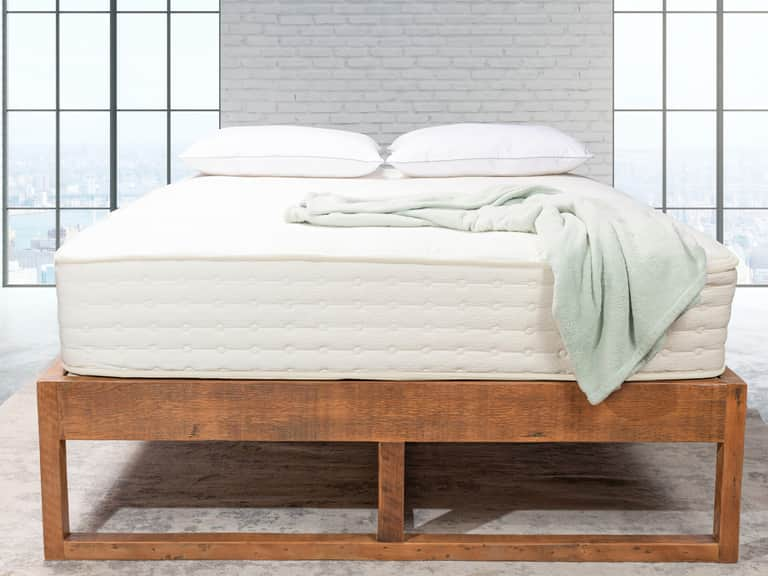
For a simple platform-style option, The Clean Bedroom Taconic Bed is described as having solid-wood slats positioned no more than 2.5 inches apart, with the design intended to provide support and airflow. Those details may make it relevant to someone comparing a compatible platform foundation, but compatibility should never be assumed: confirm the mattress manufacturer’s requirements and the bed’s dimensions before deciding.
In a room where visual quiet matters, a low-profile foundation can make a bed feel less imposing and preserve a sense of open space. Yet the lowest frame is not always the most practical. Consider under-bed storage, the height needed to sit down comfortably, access for cleaning, and whether the mattress requires a particular base. A measured, functional choice tends to look better over time than a frame selected for appearance alone.
Natural materials and responsible questions
“Natural latex” speaks to a material category, but it does not answer every question about a mattress. If material sourcing or certifications matter to you, check the current model’s documentation and read exactly what each certification covers. Certifications can relate to particular materials, processes, or emissions criteria; they should not be treated as blanket proof of every environmental or health claim. Look for details about the latex, cover, adhesives, and any other components rather than relying on a broad label.
Care requirements matter, too. Ask whether the cover is removable, how the mattress should be cleaned, whether it needs periodic rotation, and what to do after a spill. Latex components may have specific handling instructions, and an integrated mattress should not be opened or altered unless the manufacturer says that it can be. A mattress protector can help guard against everyday moisture and soil, but confirm that the protector fits securely and does not interfere with the surface feel you want.
In compact homes, longevity is especially valuable because replacing a large item can be difficult. Good ventilation, an appropriate foundation, careful handling, and prompt attention to spills can all support responsible ownership. Follow the care guide supplied with the specific mattress rather than applying generic advice that may not suit its construction.
A practical checklist for evaluating an Obasan mattress
Before making a decision, gather the model-specific facts in one place. This makes it easier to compare options without being distracted by broad claims or attractive but incomplete descriptions.
- Construction: What materials make up each layer, and how thick is each one?
- Feel: Are firmness options available, and how does the maker describe their intended differences?
- Sleep position: Does the surface offer the kind of cushioning and responsiveness you prefer?
- Dimensions: What are the exact length, width, thickness, and weight?
- Foundation: What base types and slat spacing are approved?
- Small-space fit: Will the complete bed leave workable access to closets, doors, and storage?
- Materials: Are sourcing, processing, and certification details available for the exact model?
- Care: What are the cleaning, rotation, and protector recommendations?
- Policies: What are the current delivery, trial, return, and warranty terms?
The final impression
The appeal of a natural latex mattress lies in the way its materials and layers work together: responsive cushioning above, considered support below, and a construction tailored to a particular feel. But the word “latex” alone cannot tell you whether a mattress is right. Layer arrangement, firmness, thickness, foundation compatibility, and personal comfort all deserve attention.
For a small room, the decision extends beyond what happens when you lie down. A well-chosen mattress must also fit the frame, clear the doorway, allow the room to function, and suit the ventilation and care needs of the space. Measure first, verify specifications, and treat the foundation as part of the design. Those quiet practicalities are what allow a beautifully made bed to feel effortless—not only at bedtime, but throughout the life of the room.
Frequently asked questions
Do all natural latex mattresses have the same feel?
No. The number, thickness, firmness, and arrangement of the layers can all influence the feel. Covers and foundations also play a part. Compare the specifications for the exact model rather than relying on the material name alone.
Does a layered latex mattress automatically sleep cool?
No mattress can guarantee a particular temperature experience. Material and construction may affect airflow, but room ventilation, sheets, protectors, duvet weight, and personal comfort also matter.
Can I put a latex mattress on any platform bed?
Not necessarily. Check the mattress maker’s foundation requirements, including slat spacing and center support, and compare them with the platform’s specifications. Also confirm that mattress and frame dimensions match.
What is the first small-space measurement to make?
Measure the usable floor area and the complete bed footprint, including the frame—not only the mattress. Then check door swings, closet access, walkways, storage, and the route needed to bring the mattress into the room.